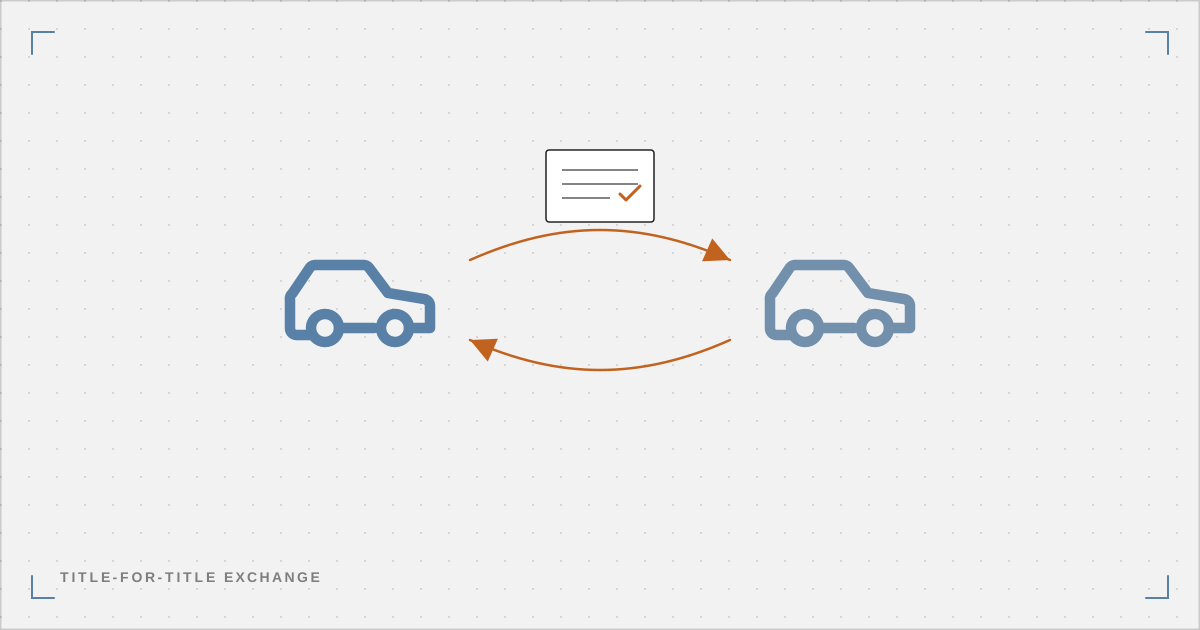
Yes — trading vehicles directly with another private individual is legal in all 50 states. A car swap is simply two ordinary vehicle sales happening at once: you sell your car to the other owner, they sell theirs to you, and any difference in value is settled with cash. Here is exactly how the legal side works, what paperwork you need, and where people most often get it wrong.
Is Private Vehicle Swapping Legal in the United States?
Yes. No state DMV, Motor Vehicle Commission, or Department of Revenue treats a car-for-car trade between private individuals as anything unusual. Legally, a swap is just two simultaneous transfers of vehicle ownership — the same title-signing, bill-of-sale, and registration process you would go through if you sold a car for cash, done twice, back to back.
There is no federal or state law that requires vehicles to be exchanged only for money. A title can be transferred for cash, for another vehicle, for a combination of both, or even as a gift — what matters to the DMV is that the transfer is documented correctly and that any sales tax owed on the vehicle(s) received is paid at registration.
What a Car Swap Actually Is, Legally
There is no special "vehicle swap" form in most states. Each party is completing a standard private-party purchase — they are just paying for it with a car (plus or minus cash) instead of an all-cash payment. That means each side needs to satisfy the same requirements a private buyer normally would:
- A properly signed, lien-free (or lien-released) title from the other owner
- A bill of sale documenting what was exchanged and any cash difference
- A completed odometer disclosure
- Proof of insurance before driving the "new" car home
- Payment of any sales tax due, at registration
The Documents Both Parties Need
Have these ready before you meet, not after:
- The original title, signed over by the legal owner — no cross-outs or white-out. Most states require the seller's signature, the buyer's information, the odometer reading, and the sale date directly on the title itself.
- A bill of sale for each vehicle (or one combined document covering both), listing both VINs, both parties' names and addresses, the agreed fair market value of each car, and any cash equalization paid.
- An odometer disclosure statement. Federal law (the Truth in Mileage Act, enforced through 49 CFR Part 580) requires a mileage disclosure on nearly every vehicle transfer for model years within the last 20 years. Many states print this section directly on the title; if there's no room, or the title is held electronically by a lender, you'll need a separate disclosure form.
- A lien release if either car has an existing auto loan — you cannot legally sign over a title with an active lien until the lender has been paid and has released its interest.
- Valid ID and proof of insurance for the vehicle you are about to drive away in.
Falsifying an odometer reading, or skipping the disclosure entirely, is a federal offense — not just a state paperwork issue. Fill it out even if you and the other owner trust each other completely.
Step-by-Step: How the Legal Exchange Works
- Verify the VIN and vehicle history on both cars before agreeing to anything. See our VIN verification guide for the exact process.
- Confirm fair market value on both sides and agree on a cash equalization amount if the vehicles aren't equal in value.
- Meet in person, ideally at a police-monitored safe exchange zone, and inspect and test-drive both vehicles in daylight.
- Sign the titles, bill(s) of sale, and odometer disclosures for both vehicles at the same time, in the same meeting.
- Exchange keys and any lien-release paperwork, and photograph the odometer, VIN plate, and condition of each car before you part ways.
- Register the vehicle you received with your state DMV within your state's deadline — commonly 15–30 days — and pay any sales tax due.
What If One Car Still Has a Loan?
A car with an outstanding loan can still be part of a swap, but the lien has to be cleared first. The owner with the loan should contact their lender for an exact payoff quote (not just their monthly statement balance — payoff figures include interest accrued since the last payment), settle it, and get written confirmation the lien has been released before signing the title over. If there isn't enough equity to cover the payoff, that owner will need to cover the shortfall out of pocket as part of the deal.
Do You Pay Sales Tax on a Car Swap?
In most cases, yes — swapping is not a tax-free workaround. Each party typically owes sales tax on the fair market value of the vehicle they receive, calculated at registration, the same way a private-party cash purchase is taxed. Rules and rates vary significantly by state. We cover the full breakdown, including states with flat caps and states with no trade-in credit at all, in our state sales tax guide.
Frequently Asked Questions
Do the two cars have to be worth exactly the same amount?
No. Unequal-value swaps are extremely common — the owner with the lower-value car simply pays the difference in cash, documented in the bill of sale as a cash equalization amount.
Can I swap cars with someone in a different state?
Yes, but you'll each register your "new" vehicle under your own state's rules, which may mean different tax treatment, emissions requirements, or title formats on each side. Confirm your home state's specific requirements before you finalize the trade.
Do I need a lawyer or notary?
Most states don't require notarization for a standard title transfer, though a handful do — check your state's title back for a notary block. A lawyer isn't required for a routine swap, but is worth considering for a high-value trade or anything with a complicated lien situation.