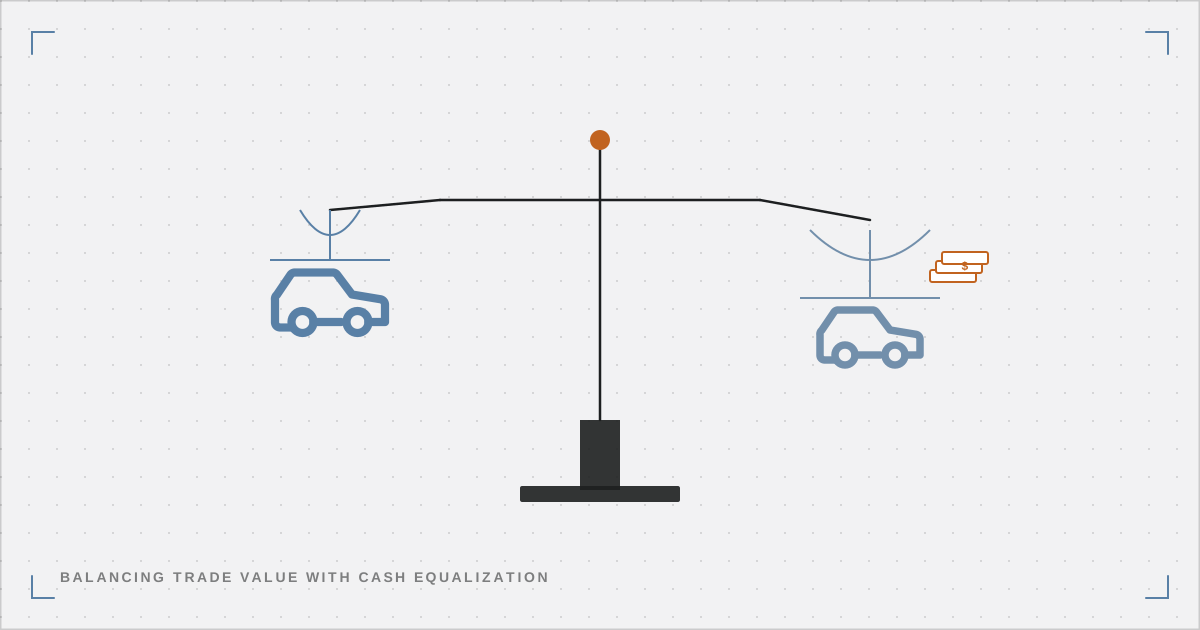
Determining whether two cars are worth swapping comes down to comparable market data, not the asking price either owner had in mind. Here is how to pull real numbers, adjust them correctly, and land on a cash equalization figure both sides can trust.
Start With the Right Value, Not the Asking Price
A dealership sticker price is inflated by overhead, reconditioning costs, and negotiation room built in — it was never meant to reflect what a private individual would actually pay another private individual. For a peer-to-peer swap, the number that matters is private party value: what a real buyer would reasonably pay a real seller for that specific car, in that specific condition.
Trade-In Value vs. Private Party Value vs. Retail Value
| Value type | What it means | Typically... |
|---|---|---|
| Trade-in value | What a dealer would offer to take the car off your hands toward another purchase | Lowest of the three — the dealer prices in reconditioning and resale risk |
| Private party value | What you could reasonably expect selling directly to another individual | The right number for a peer-to-peer swap |
| Retail value | What a dealer would list the same car for on their lot after reconditioning | Highest of the three — includes dealer margin |
Get Both Numbers From at Least Two Sources
Look up each vehicle's private party value on Kelley Blue Book and Edmunds separately, entering the exact year, make, model, trim, mileage, and condition for both cars. The two tools use different data sets and occasionally diverge by a meaningful amount — cross-checking both, plus a quick look at comparable listings for the same model in your area, gives you a realistic range rather than a single number either party can dispute.
Adjust for Condition, Mileage, and Region
The base value from a pricing tool assumes "average" condition and mileage for the model year — real cars rarely match that exactly. Before locking in a number, adjust for:
- Mileage — significantly above or below the average for the model year moves value up or down
- Condition — interior wear, paint, and mechanical issues beyond routine maintenance
- Accident or title history — a clean CARFAX/AutoCheck and no title brands supports full value; a reported accident or branded title should lower it
- Tires, brakes, and upcoming maintenance — a car due for a timing belt or new tire set soon is worth less than the same car that just had that work done
- Region — demand for certain body styles (trucks, AWD, convertibles) shifts by climate and local market
The Cash Equalization Formula
Once both private party values are set, the math is simple:
Cash difference owed = Higher-value car's price − Lower-value car's price
For example, if your car is worth $18,000 and the car you want is valued at $16,000, a fair trade means the owner of the $16,000 car adds $2,000 in cash to equalize the exchange. Both parties should sign a bill of sale that documents each vehicle's agreed value and the cash amount separately — this figure also typically becomes the basis for sales tax owed at registration, so keep it accurate. See our sales tax guide for how that's calculated.
A Simple Fairness Checklist
- Pull private party value from at least two sources for both vehicles
- Confirm mileage and condition match what each pricing tool assumed
- Pull a vehicle history report on both cars and adjust for any accidents or title brands
- Factor in anything mechanically due soon (tires, brakes, timing belt, registration renewal)
- Agree on a cash equalization figure and write it into the bill of sale
- Confirm what sales tax each of you will owe on the value received before you finalize anything